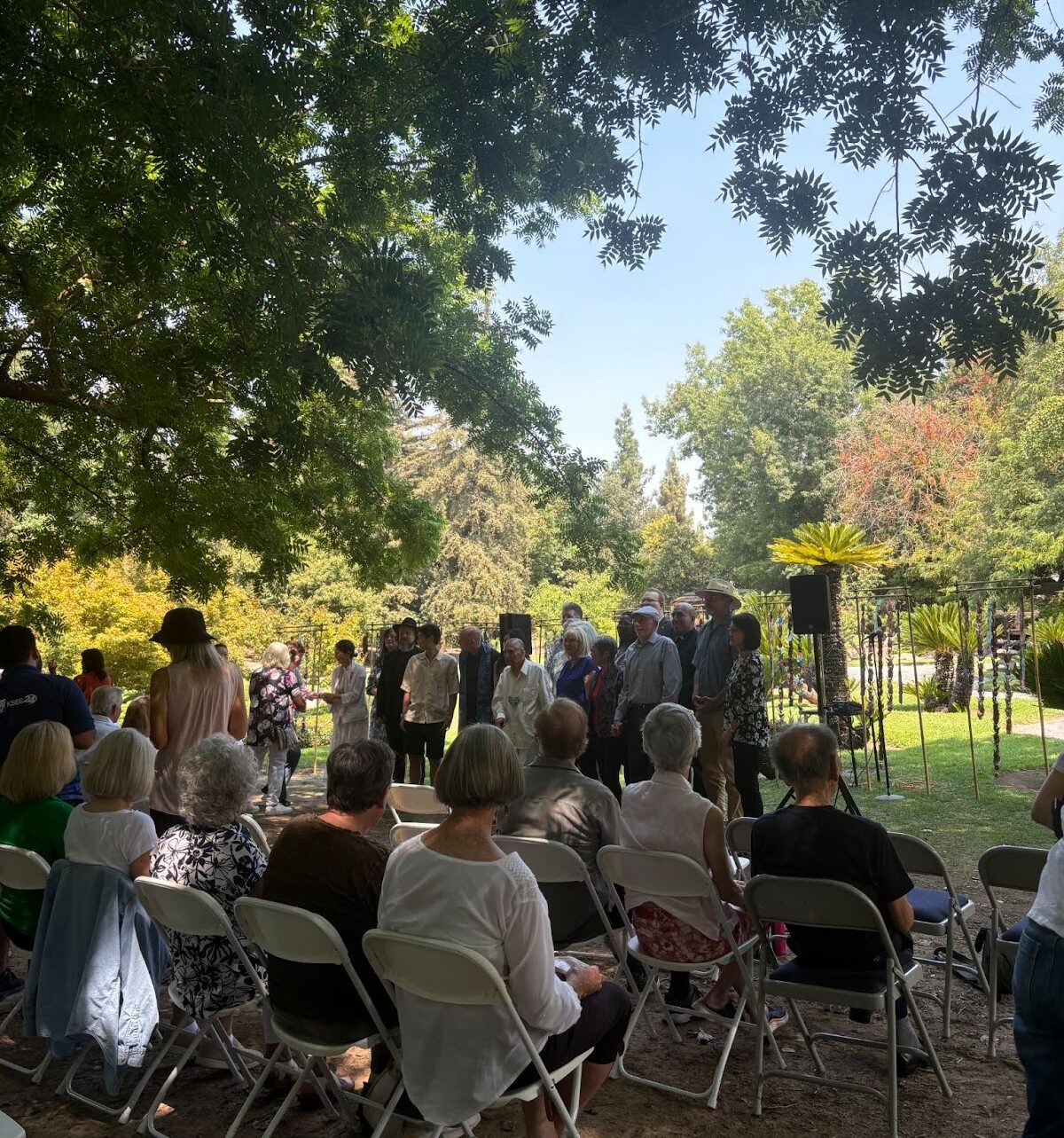
On August 6 and 9, over 80 Fresno community members gathered at the Fresno State Peace Garden and the Shinzen Friendship Garden to commemorate 80 years since the atomic bombings of Hiroshima and Nagasaki.
Both locations were decorated with colorful paper cranes, symbolizing healing, hope, and peace. The cranes were folded by the Fresno Buddhist Temple, the United Japanese Christian Church, and the fifth grade classes at Ann B. Leavenworth Elementary School.
One of the Leavenworth teachers, Jaime Bañuelos, said that the folding of the cranes was accompanied with lessons on Japanese history through the story of Sadako, one of the many children impacted and eventually killed by the first atomic bomb in Hiroshima.

“Because [the story] was so meaningful, the students were motivated to do the paper cranes as a symbol of peace,” Bañuelos said.
Peace was a recurring theme. Bernadette Vasquez, event organizer and co-chair of the Human Rights Coalition of the Central Valley, said, “It’s not a celebration, it’s a commemoration.”
The representatives, youth, and community members invited to speak were chosen intentionally, “with a message of what [the commemoration] means to them,” Vasquez described.
Dr. Joy Goto, co-chair of the Human Rights Coalition of the Central Valley, had a more personal connection to the commemoration as a third generation Japanese-American.
“My mother is from the Hiroshima area; [she was] maybe about 10-12 miles from the hypocenter of the atomic bomb,” Dr. Goto said. “She was eleven years old.”
Due to her personal connection, Dr. Goto is dedicated to supporting the Japanese community in Fresno. “The Fresno County area has always [held] a large number of people from the Hiroshima area, because a lot of them were involved in agriculture.”
The first commemoration was held on Wednesday, August 6 at the Fresno State Peace Garden. The date marked 80 years since the first atomic bomb was dropped on Hiroshima. The paper cranes were strewn around the statues of various historical peace figures, with the most recent addition being Nelson Mandela.
The event featured a diverse group of speakers, including religious leaders, political representatives, community leaders, and youth.
Dr. Daniel O’Connell, member of the Quaker faith, led a moment of silence at 8:15 a.m., the exact moment the atomic bomb was dropped in 1945. Dr. O’Connell then invited event attendees to begin a fast in solidarity, to honor the lives lost and harmed by the bomb.
“It’s a spiritual experience,” Vasquez commented regarding the fast.
One of the event’s speakers and a member of Gakko Gives, Jaya Hiyama, described that her grandparents were in Japan during the atomic bombings. “It’s really important to commemorate it, and make sure that something like this doesn’t ever happen again,” Hiyama stated.
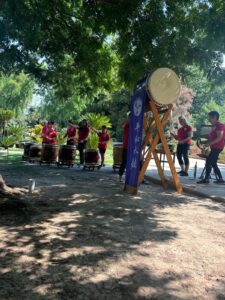
The second commemoration, held on Saturday, August 9, marked 80 years since the second atomic bomb was dropped on Nagasaki. The event was held at the Shinzen Friendship Garden in Woodward Park, and brought together about 80 community members of all ages.
The event was structured similarly to its predecessor, with diverse speakers sharing their perspectives and support for the Japanese community. The fast started by Dr. O’Connell on the 6th ended, and a moment of silence was held at 11:02 a.m., the moment when the atomic bomb was dropped on Nagasaki.
The commemoration ended with a symbolic distribution of bracelets, appropriately named the link of love, which – both literally and figuratively – united the attendees. As demonstrated by the paper cranes strewn about the garden, healing, hope, and peace were the core values of the event.
“I’m praying that we remember to not repeat history,” expressed organizer Irene Ikeda. “It’s so easy nowadays to look forward, but you forget to look backward.”
For this reason, organizer Dr. Joy Goto explained that “by commemorating the event every year, we always remember and [don’t] forget these types of violence.”
Vasquez explained, similarly, “We should really commemorate those atomic bombings on those specific dates to bring attention and education. If you educate the public, then they know how to respond if countries around the world are again going to use that kind of weaponry.”
Vasquez and Dr. Goto hope to motivate the Fresno community to be proactive. Their goal is to motivate and inspire the public to take action in civic matters. Both organizers hope that the youth, especially, become involved in social causes as much as possible.
Similarly, Ikeda said, “I’m hoping the youth will be proactive in human rights so we don’t repeat the same thing.” Ikeda’s message was the core of the commemoration: we must use the lessons of our past to reshape our future.