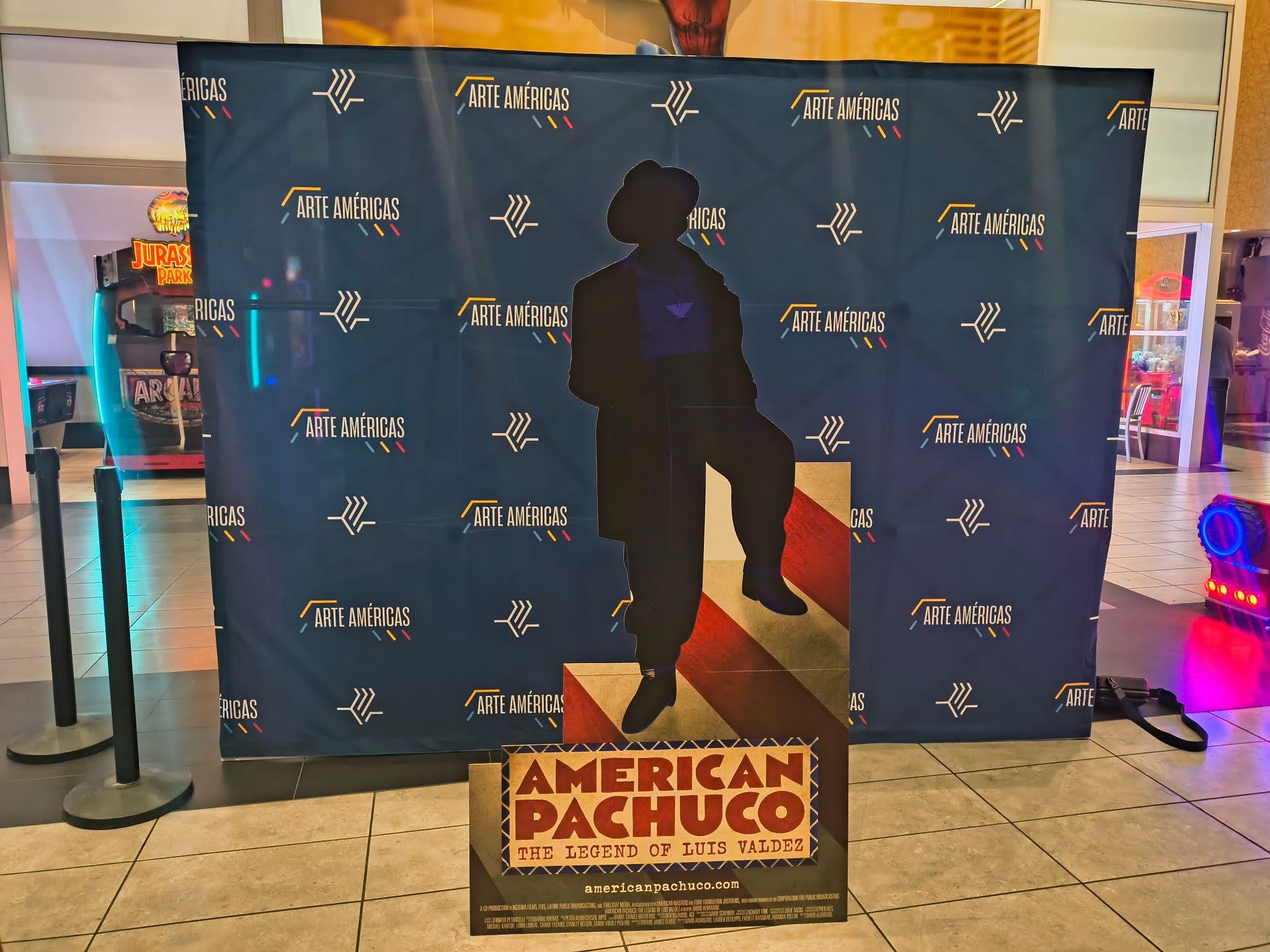
On Saturday, Aug. 8, the story of Chicano theater, farmworker activism and cultural identity came home to the Central Valley.
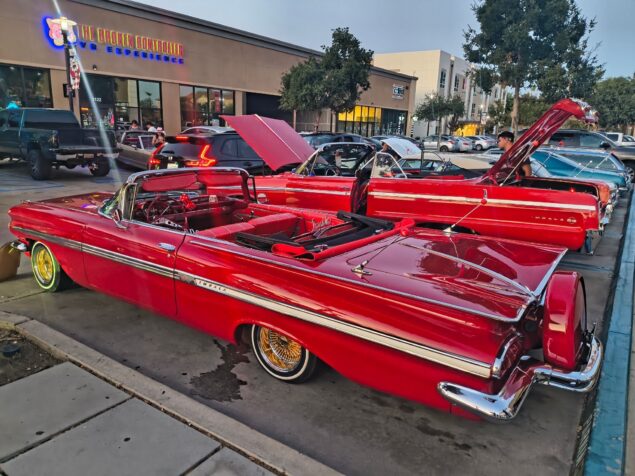
“American Pachuco: The Legend of Luis Valdez” screened at Maya Cinemas in Fresno, followed by a live Q&A with director David Alvarado, producer Everett Katigbak and interviewer Joseph Rios. Outside the theater, a block party at Campus Pointe brought together lowriders, food, music and local vendors, creating a community celebration around a film about the power of art and storytelling.
The documentary follows the life and work of Luis Valdez, the playwright, filmmaker and founder of El Teatro Campesino, a performing arts theater in San Juan Bautista. Valdez began performing for farmworkers in Delano from the back of a flatbed truck, using theater to tell stories about exploitation and encourage workers to join the farmworker movement.
His career would eventually take him far beyond the fields. He wrote Zoot Suit, the first Chicano play to reach Broadway, and directed “La Bamba,” which introduced audiences to the story of rock-and-roll musician Ritchie Valens. Throughout his work, Valdez used theater and film to place Mexican American and Chicano stories at the center of American culture.
For Alvarado, bringing the documentary to Fresno carried a particular significance.
“The film started in 2021 and was always going to be a film about belonging in America,” Alvarado said during the Q&A. He described Valdez’s life and work as a testament to belonging, particularly at a time when questions about who belongs in the country have once again become prominent.
The film, he said, was ultimately created around “joy, strength, community, family and love.”
“That’s why it’s a good fit for now,” Alvarado said. “Because we need more of that right now.”
Fresno’s connection to Valdez runs deep. Valdez was born in Delano, spent time working in the fields throughout the Central Valley and brought El Teatro Campesino through communities across the region. His first film, “I Am Joaquin,” based on a poem by Chicano activist and poet Rodolfo “Corky” Gonzales, was filmed in Fresno.
Rios, who is from Fresno and works at Arte Américas, moderated the Q&A. For him, the responsibility of interviewing the filmmakers went beyond simply asking questions about the documentary.
“I think for me more, the responsibility I felt was to represent a Fresno audience,” he said.
Rios wanted to repeatedly bring the conversation back to why the film mattered specifically in Fresno.
“It’s hard to talk about Luis without talking about the Central Valley,” he said.
Rios said one of the most powerful takeaways from the documentary was seeing how theater and storytelling can function as forms of activism.
“Theater and storytelling can be a powerful activist tool,” he said, adding that theater, poetry, filmmaking and storytelling have long existed alongside Chicano activism.
That history of cultural collaboration also extends beyond the Mexican American community.
During the Q&A, Katigbak discussed the Filipino-Chicano relationship and its importance to the farmworker movement. Katigbak, who is Filipino American, said he grew up in East Los Angeles surrounded by Chicanos and Mexicans. His understanding of Filipino American history eventually led him to the story of Filipino farmworker organizer Larry Itliong. That history also shaped his connection to Valdez’s work.
“The United Farmworkers became a movement because the Filipinos and Mexican unions joined together,” Katigbak said.
The connection is also reflected in “La Bamba,” where Ritchie Valens is portrayed by a Filipino actor. Katigbak said seeing a Filipino actor portray Valens created an interesting tie around representation: Chicano and Latino audiences could see themselves in the character while the actor portraying Valens was Filipino.
For some audience members, the documentary was less about learning an unfamiliar history, but seeing their own lives reflected on screen.
Chicana artist Liyah Guardiola, who was born in Visalia and spent much of her life in Tulare, presented Alvarado and Katigbak with an engraved mirror featuring the film’s “American Pachuco” poster design following the Q&A.
Guardiola created the piece herself, transferring the design onto the mirror and engraving it using a Dremel with diamond-grit tips. Her work also reflects the Central Valley’s connection to lowrider culture. She is currently learning pinstriping, airbrushing, car rebuilding and other techniques at a local shop.
“It is amazing,” Guardiola said of being a Chicana artist in the Central Valley. “There are so many people out here who push me every single day to become better, achieve more.”
The documentary, however, gave her a different perspective on her own artistic journey.Guardiola said she grew up Mexican American but had not always felt connected to her culture.
“I look very pale, very white and I never really knew my culture,” she said. “Now that I’m 20 I’m starting to learn it.”
Seeing Valdez’s story presented her with a larger picture of a history she had previously encountered only in fragments. More importantly, she saw something of herself in Valdez.
“It reminded me of me,” Guardiola said.
Before watching the documentary, she had worried that turning her art into work might take away the passion she had for it. Instead, she said the film renewed that passion.
For Rios, that desire to create and tell stories is one of the reasons young people from the Central Valley should not dismiss their connection to the region.
Rios said he once had the same mentality as many young people who see leaving Fresno as the ultimate goal. He spent about 10 years away, living in the Bay Area and Los Angeles, but said he never completely separated himself from Fresno.
“My whole family’s been in Fresno for over 100 years,” he said.
Leaving, he explained, does not necessarily mean abandoning home.
“You can go learn and get skills elsewhere if you want, as long as your focus is still here,” Rios said. “There’s a whole lot of history and you can build on that.”
Ultimately, he said, the Central Valley remains part of the people who come from it.
“It’s not always either or if you choose to stay or go,” Rios said. “It’s just Fresno. It never leaves you. It’s always a part of you wherever you’re at.”
That idea echoes the story at the center of American Pachuco. Valdez’s work began in the fields of the Central Valley but eventually reached Broadway, Hollywood and audiences across the country. His story demonstrates how art created from a particular place and community can ultimately reach far beyond it.
At Maya Cinemas, generations of Central Valley residents gathered to watch that history unfold and then added their own stories to it.
“American Pachuco: The Legend of Luis Valdez” will continue screening at Maya Cinemas through Aug. 13. The filmmakers are also raising funds through Kickstarter to bring the film to more theaters and audiences.