
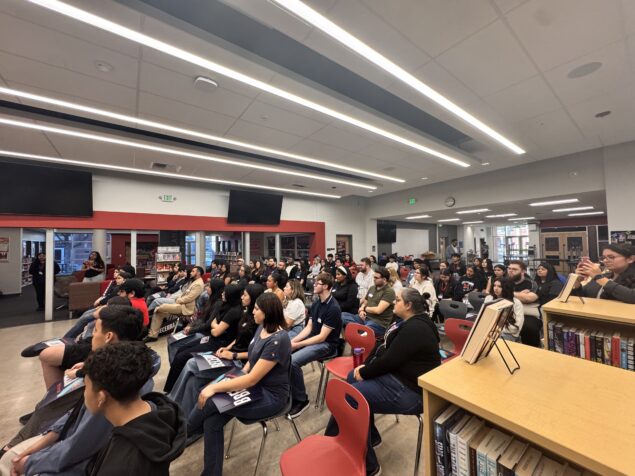
Standing before 50 high school students from all around Fresno, gubernatorial candidate Xavier Becerra framed his campaign around how he’s going to make life better for young Californians.
The state’s youth, he said, should be able to build stable lives with access to housing, education and healthcare. More than that, Becerra says that when he was young, he found people that would advocate for him – now Becerra wants to help those people by fighting for them.
“This campaign is about the next generation,” Becerra told students during a forum in Fresno. “I’ve been fortunate [that] someone fought for me. Now I have to show the same fight for them.”
Becerra, who previously served as California’s attorney general and U.S. Secretary of Health and Human Services under the Biden administration, emphasized that his upbringing shaped his focus on young people and working families.
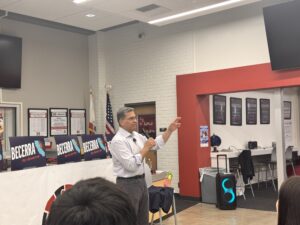
He recounted how his parents immigrated with little money and still found a path to homeownership and college for their children. He said his goal as governor would be to ensure similar opportunities remain possible.
According to Becerra, the Central Valley has long been overlooked by state leadership, leaving younger residents to face rising costs and limited resources despite Fresno being the fifth largest city in California. Becerra said one of his first priorities would be greater regional investment.
“The most important thing I can do for young people in the Valley is pay attention to the Valley,” he said. “We have to focus on everybody, not just Los Angeles or San Francisco.”
Students pressed Becerra on specific policies, including the affordability crisis affecting young renters and college students. He responded that expanding the housing supply would be essential to reducing costs, especially near universities.
“There are students right now living in their cars because they can’t afford an apartment,” Becerra said. “We need to build more housing, and we need to make sure some of it is built around campuses.”
He also highlighted plans to stabilize energy and insurance costs, which he said disproportionately burden younger Californians trying to establish financial independence. Transparency in pricing and regulation of excessive rate increases would be key steps.
Healthcare access emerged as a central theme throughout the forum, both by Becerra and students. He warned that recent federal policy changes could reduce coverage for low income families – pointing out President Donald Trump’s Big Beautiful Bill – but pledged that California would continue investing in preventive care.
“It is easier to build strong children than to repair broken men,” he said, citing abolitionist Frederick Douglass. “We need to spend money to prevent problems before families lose everything in a medical crisis.”
Drawing on his experience leading federal health programs, Becerra pointed to initiatives such as the 988 mental health crisis line and community behavioral health clinics as models he would expand statewide. The programs provide immediate support for people facing mental health or substance use challenges and reduce strain on schools and families.
Becerra also said programs like 988 are key to rebuilding trust and transparency in local communities, as this is a way to reduce police response on someone during a mental health crisis. This would lead to increased jobs and better access to mental health resources.
“We need more mental health professionals,” he told students. “If we build that network now, no family should have to go without help.”
Youth mental health has become an urgent issue in the Central Valley, where shortages of counselors and providers have left many students without adequate care along with cuts to similar programs. Becerra said expanding the workforce and clinic network would be a top priority.
Beyond policy proposals, Becerra stressed that young people themselves should play a role in shaping state government. He encouraged students to participate through internships, advisory groups and public service roles.
“If I’m going to do this right, I have to hear from the people I’m impacting most,” he said. “I want you to be part of the work we do.”
He pledged to continue visiting Central Valley communities as governor, arguing that sustained engagement is necessary to address regional disparities. His personal ties to the area, including family roots in Fresno County, reinforced his message that the region deserves equal attention.
“Good things happen in the Valley,” Becerra said. “Great people live here, and we have to pay attention.”

While his campaign has focused on policy details and experience in public office, Becerra acknowledged that voters ultimately want tangible improvements in their daily lives. He cited his statewide electoral record as evidence that a results-driven approach can attract support across party lines.
“Most people want to know how their life will be made better,” he said. “That’s what matters.”
For many students in attendance, the discussion represented an early glimpse into the state’s political future. Becerra said he hopes his policies will create conditions in which today’s youth can thrive as adults.
“If I leave the governor’s office after eight years, it should be because we helped build the systems you will rely on,” Becerra said.
His message underscored a broader campaign theme that California’s long-term success depends on investing in the well-being of its youngest residents.
By focusing on affordability, health and civic participation, the state can restore confidence among young people facing economic and social uncertainty.
“We have to make sure California is still a place where you can make your own future,” Becerra said.